Choosing a material for high-temperature service is rarely about finding the alloy with the highest temperature capability and best resistance to an environment. In many applications, the ideal choice is the alloy that offers the right balance of desirable properties and cost. Oftentimes, RA330® occupies that middle ground.
RA330® is an iron-nickel-chromium-silicon alloy that contains approximately 35% nickel, 19% chromium, and 1.25% silicon. This composition places it between traditional heat-resistant stainless steels, such as 309and 310, and higher-nickel alloys like 600and 601. As a result, RA330® offers a unique combination of properties that can serve as a strong alternative when 309 or 310 stainless steel is nearing its limits, or when a higher-nickel alloy is more than the application requires or is too costly to consider.
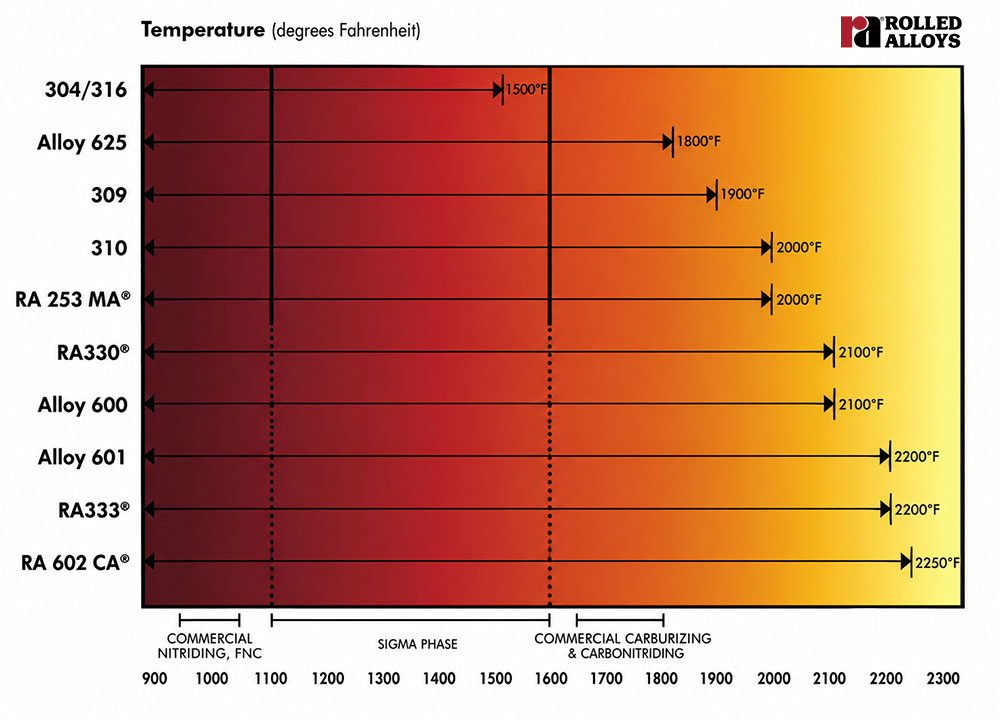
One of RA330®’s most important advantages is its high-temperature oxidation resistance. RA330® was designed for oxidation resistance up to approximately 2100°F, offering higher temperature capability than common heat-resistant stainless steels such as 309 and 310. Compared with select nickel alloys such as alloy 600 and 625, RA330® offers higher or comparable oxidation resistance at a lower cost. Below is a table showing a variety of heat-resistant alloys, comparing their oxidation limits relative to one another.
When selecting materials for industrial heating applications, carburization and nitridation resistance can be crucial to consider.
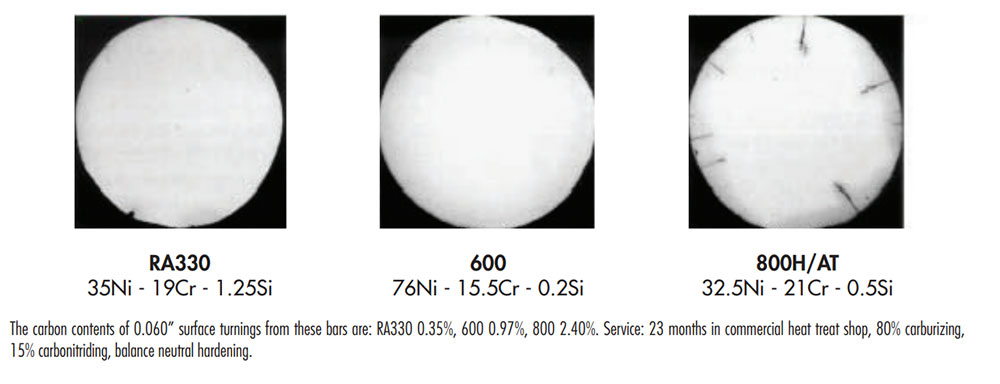
RA330®, with its 35% nickel content, is often seen as optimal for both mechanical properties and resistance to carburization. Silicon plays a significant role in enhancing carburization resistance, with a nominal content of 1.25% being particularly effective. It’s important to note that mechanical and thermal stresses can damage the protective layer on alloys, affecting their carburization rates. The true effectiveness of these materials is best evaluated under real service conditions, as shown in the rod frame basket heat-treating trial below.
RA330® shines when thermal cycling and thermal shock are a concern. RA330® maintains a controlled grain size, resulting in a material composed of fine grains. Fine grains can be rather beneficial in thermal processing, as they distribute internal stress more evenly and can help prevent microcracks from propagating as a higher density of grain boundaries in a material can help impede thermal crack growth. This gives RA330® an advantage in applications where components are repeatedly heated, cooled, or quenched. This is an important consideration when comparing RA330® to a coarse-grained material like 800H/AT, which is designed predominantly for high long-term creep strength. Although a grade like 800H/AT offers higher creep strength than RA330®, it tends to be much more prone to cracking when exposed to thermal cycling or severe thermal shock.
In addition to RA330®’s controlled grain size, RA330® is extremely stable metallurgically. The alloy remains fully austenitic under room temperature and operating conditions. When welded, the welded region also remains fully austenitic. Additionally, at operating temperatures between 1100–1600°F, RA330® is not subject to sigma-phase embrittlement, unlike lower-alloyed heat-resistant stainless steels such as 309 and 310. The reasoning for this is that RA330® contains a nominal 35% nickel, which is sufficient to prevent sigma phase precipitation.
The high-temperature strength of RA330® has been briefly discussed before, but it is important to highlight that RA330® has a creep strength that exceeds that of grades like 309 and 310 at the upper limits of usage and is slightly lower than nickel alloys such as 600 and 601.
Below is a creep strength table showing the average stress in ksi required to yield a 1% in 10,000-hour minimum creep rate for a variety of heat-resistant alloys for comparison.
Creep Stress Values by Alloy and Temperature
Alloy
Temperature, °F
1200
1300
1400
1500
1600
1700
1800
309
16
8.8
3.4
2.4
1.4
0.6
0.22
310
14.9
5.9
3.3
2.1
1.1
0.57
0.28
RA330®
7.6
5.3
3.6
2.7
2.1
1
0.5
800 H/AT
17
9.1
6
–
3.6
1.5
1.05
601
18
7.2
4.1
2.7
2
–
0.76
600
–
–
3.6
–
0.75
–
0.56
Note: All creep stress values are reported in KSI (kilopounds per square inch). A dash (–) indicates no value provided in the source table.
Wrought vs. Cast Alloys: Fabrication and Repair Considerations
RA330®’s versatility also comes from its wrought construction. Wrought products can offer advantages over cast products when thermal cycling, handling, repairability, and weight are important considerations. Additionally, the controlled processing of wrought material helps produce a more uniform product, reducing the shrinkage and porosity concerns that can occur in castings.
Wrought construction can also be advantageous when equipment experiences repeated thermal shock. Wrought materials retain greater ductility and develop lower internal thermal stresses due to the ability to make components in thinner sections compared to castings, which are most typically thicker. For equipment such as heat-treating baskets and radiant tubes, thinner sections can also reduce the amount of material to be heated in each cycle. The resulting reduction in weight and thermal mass can improve efficiency and reduce the dead weight carried during repeated heat-treatment cycles.
Repairability is another consideration. Castings have inherently low ductility to begin with, and when exposed to high temperatures, they can lose ductility over time, making repair welding more difficult. The ability of wrought material to maintain useful ductility can therefore be an important advantage when equipment must be repaired or returned to service.
RA330® Product Forms and Fabrication Options
Fabrication is another part of RA330®’s versatility. RA330® is available in forms including plate, sheet, bar, pipe, expanded metal, threaded bar, nuts, washers, and welding consumables. As for forming, RA330® forms similarly to other austenitic stainless steels and can be welded using RA330-04 filler, which was specifically designed to reduce the tendency to hot crack, a common problem with generic ER330.
When taken as a whole, RA330® finds usability across a broad range of high-temperature equipment. Typical applications include furnace muffles, retorts, heat-treating baskets, quenching fixtures, radiant tubes, furnace fans and shafts, conveyor pins, and furnace equipment for carburizing and nitriding.
RA330® is not intended to replace all heat-resistant stainless steels or nickel alloys. Its primary value lies in providing a balanced combination of high-temperature performance, environmental resistance, thermal shock resistance, practical fabrication, and cost.
Discover how RA330® delivers oxidation resistance, thermal stability, and reliable performance in high-temperature environments. Explore its advantages for heat treating furnaces, industrial equipment, and demanding
We make it easy to get instant pricing and purchase your metal at the click of a button. Track your order progress, get notified when it ships, and follow your shipment online until it’s delivered. It’s that easy!
Discover how RA330® delivers oxidation resistance, thermal stability, and reliable performance in high-temperature environments. Explore its advantages for heat treating furnaces, industrial equipment, and demanding applications where material selection matters.
Manage your eService programs faster with the new dashboard widget from Rolled Alloys. Track inventory, releases, schedules, and recurring material orders in one centralized view.